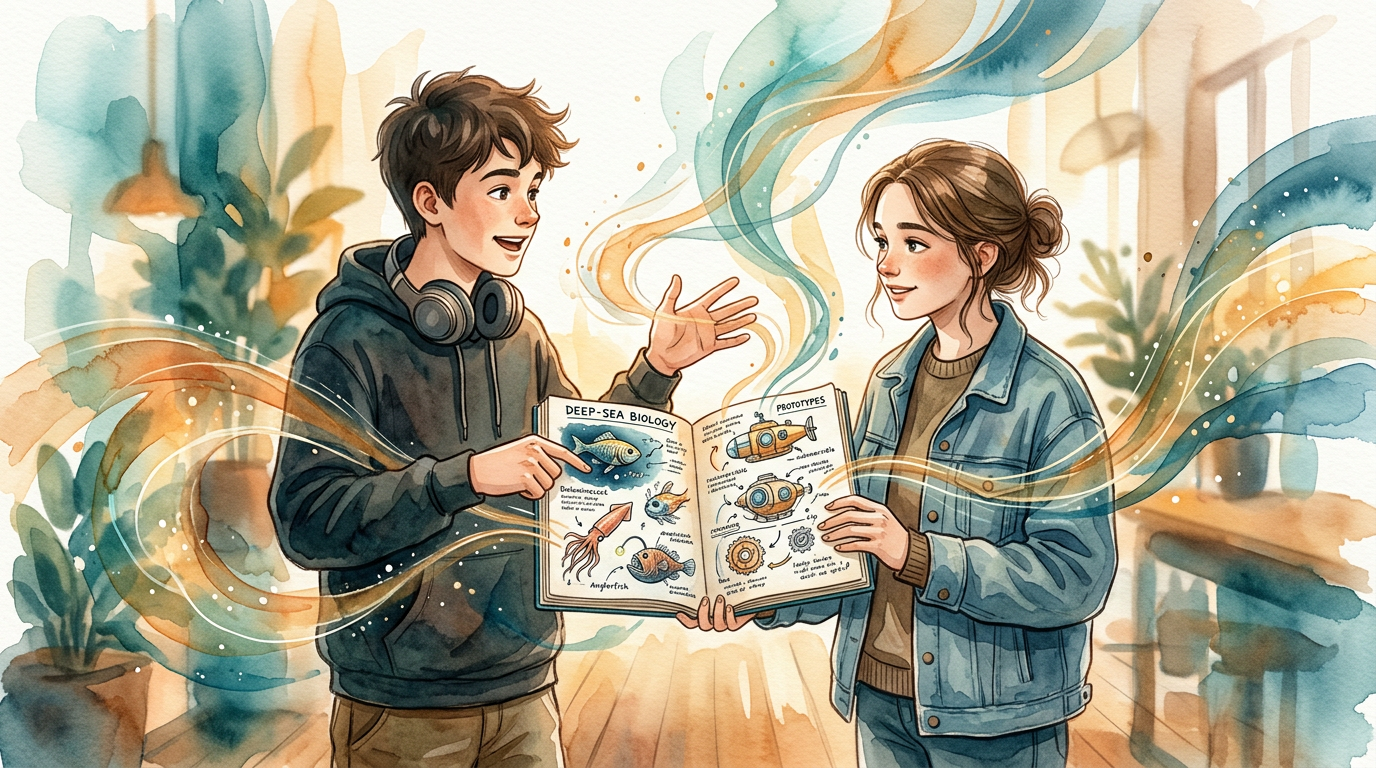
Picture this. A 15-year-old sits at the edge of the lunch table, not because he doesn't want to talk, but because every conversation happening around him feels like a game where nobody gave him the rulebook. He knows everything about deep-sea bioluminescence. He could talk for an hour about the mechanics of submarine propulsion. But someone asked him 'what's up?' and he froze — because what does that even mean, literally?
This is the experience of countless autistic teens every single day. And the problem isn't that they can't connect. The problem is that most of the advice we hand them — the scripts, the social skills curricula, the well-meaning tips — was written for a different kind of brain.
This article takes a different approach. Instead of treating autism as a social deficit to be corrected, we're going to look at what actually works: conversation starters and frameworks built around how autistic teens genuinely communicate, what they genuinely care about, and where their real strengths lie. If you're a parent, educator, therapist, or a teen yourself trying to figure this out — this is for you.
Why Standard Conversation Advice Often Fails Autistic Teens
Most conversation guides — including many aimed at teens — are built on a set of invisible assumptions. Assume the other person wants small talk. Assume eye contact signals engagement. Assume that mirroring body language builds rapport. Assume that a pause means it's your turn to speak.
These assumptions work reasonably well for neurotypical communicators. But for autistic teens, they can actively get in the way.
Here's the thing: autism spectrum disorder involves real differences in social communication — not deficits in the desire to connect, but differences in how that connection happens. When we hand autistic teens a script built for neurotypical defaults and tell them 'this is how you make friends,' we're essentially asking them to perform a social character that isn't theirs. That's exhausting. And it rarely leads to genuine connection.
The neurodiversity-affirming approach flips this. Instead of asking 'how do we fix the autistic teen's communication style?' it asks 'how do we build conversation contexts where autistic teens can actually thrive?' That shift changes everything — from the starters we suggest, to how we measure success.
Before vs. After: Two Approaches to Teen Social Skills
| Deficit-Based Approach | Neurodiversity-Affirming Approach |
|---|---|
| 'Practice making eye contact' | 'Eye contact is optional — focus on the conversation' |
| 'Learn to ask follow-up questions' | 'Use your natural curiosity about topics you care about' |
| 'Don't talk too long about your interests' | 'Find people who share your interests — they'll want to hear more' |
| 'Mirror the other person's body language' | 'Authentic body language reduces social masking fatigue' |
| 'Small talk is the entry point' | 'Direct, interest-based openers often work better' |
| 'Reduce stimming in social situations' | 'Regulated sensory needs = better conversational presence' |
The right column isn't just kinder. In my experience working with communication frameworks across many different populations, it's also more effective.
Understanding How Autism Affects Conversational Dynamics
Before we get to specific starters, it helps to understand the mechanics. What's actually happening when an autistic teen finds conversation difficult — and where are the hidden strengths?
Differences in Turn-Taking and Timing
Neurotypical conversation has an almost musical rhythm to it — overlapping speech, rapid back-and-forth, subtle cues that signal 'your turn now.' Autistic teens often process these cues differently. They may need more time to formulate a response. They might not pick up on the subtle shift in tone that signals the other person is done speaking. And they may interpret interruptions — which neurotypical speakers often use to signal enthusiasm — as rude or overwhelming.
So a pause that a neurotypical teen reads as 'they're not interested' might actually mean 'I'm still thinking, give me a second.' That's a crucial distinction. And it means that conversation starters for autistic teens often work best when they're designed to allow for processing time — open-ended questions with no social pressure to respond instantly.
Special Interests as Conversational Superpowers
Look, this is the part that most social skills curricula get badly wrong. Special interests — the deep, focused passions that many autistic people develop — are routinely framed as something to manage or limit in social settings. 'Don't talk too much about your topic.' 'Ask the other person about themselves instead.'
But here's what that advice misses: passion is magnetic. When someone talks about something they genuinely love, with real knowledge and authentic enthusiasm, that's compelling. The issue isn't the special interest — it's finding the right audience and framing.
An autistic teen who's obsessed with train engineering might connect deeply with another teen who loves mechanical systems, or history, or even just appreciates someone who knows a lot about something. The goal isn't to suppress the interest. It's to create conversation entry points that make the interest accessible and inviting to others.
For more on how teens naturally gravitate toward topics they care about, what do teens actually like to talk about explores the real conversations happening between teens — and it's more compatible with autistic communication styles than most people expect.
Sensory and Emotional Regulation During Conversation
This one often gets overlooked. Conversation isn't just a cognitive task — it's a sensory and emotional one. Noisy cafeterias, fluorescent lighting, unpredictable social dynamics — these can all create a sensory load that makes processing conversation genuinely harder.
When an autistic teen is in sensory overload or emotional dysregulation, the part of their brain that handles language and social processing is competing with the part trying to manage that overwhelm. The result can look like withdrawal, flat affect, or short responses — none of which reflect how much they actually want to connect.
Conversation starters and settings that reduce sensory load (quieter spaces, one-on-one rather than group, written rather than verbal) don't just make things easier — they make genuine connection possible.
Conversation Starters That Work Well for Autistic Teens
Now for the practical part. These aren't generic scripts — they're categories of openers designed around the communication patterns and strengths that many autistic teens share. (Note: autism is a spectrum, and what works for one teen may not work for another. These are starting points, not formulas.)
For a broader foundation, the conversation starters for teens guide offers a useful baseline — and many of those starters translate well with the adjustments we'll discuss here.
Interest-Based Openers
These are the highest-percentage plays. Instead of leading with small talk ('how was your weekend?'), lead with something that connects to a known or likely interest.
- 'I heard you know a lot about [topic] — what's the most surprising thing about it?'
- 'What's something you've been really into lately?'
- 'If you could explain [your interest] to someone who'd never heard of it, where would you start?'
- 'What's a topic you could talk about for an hour without getting bored?'
- 'Is there a show, game, or book you think more people should know about?'
These work because they're direct, they have clear answers, and they invite depth rather than demanding small talk performance. And they signal to the autistic teen: your interests are welcome here.
Structured and Predictable Formats
Ambiguity is cognitively expensive. Conversation formats that have a clear structure — a beginning, a topic, a natural endpoint — reduce the mental overhead of figuring out 'what is this conversation even doing?'
- Would-you-rather questions: 'Would you rather explore the deep ocean or outer space, and why?'
- This-or-that formats: 'Strategy games or action games?'
- Hypotheticals with a clear premise: 'If you could master any skill instantly, what would it be?'
- Ranking questions: 'What are your top three [movies/games/places]?'
These formats are also popular among neurotypical teens (as explored in conversation starters for teens trying to make friends), which means they create natural common ground rather than singling anyone out.
Low-Pressure Written or Text-Based Starters
For many autistic teens, written communication removes several of the hardest parts of conversation simultaneously: the real-time processing pressure, the sensory input of face-to-face interaction, the ambiguity of tone and facial expression.
Text-based conversation starters aren't a consolation prize. They're a genuinely valid form of connection — and for some autistic teens, they're where the most authentic communication happens.
- Sharing a meme or article related to a shared interest with 'this made me think of you'
- Asking a question over text before an in-person meeting: 'I wanted to ask you something — what do you think is the most underrated [movie genre/game mechanic/historical period]?'
- Using shared online spaces (Discord servers, interest-based forums) where the topic itself provides conversation structure
- Sending voice memos instead of live calls, which allow processing time before responding
Research on autistic communication consistently shows that many autistic individuals communicate with greater complexity, nuance, and satisfaction in text-based formats than in real-time verbal conversation. This isn't a workaround — it's a genuine strength.
How to Respond When an Autistic Teen Starts a Conversation
This section is for the parents, teachers, neurotypical peers, and anyone else on the receiving end of a conversation initiated by an autistic teen.
Because here's what often happens: an autistic teen works up the courage or finds the right moment to start talking about something they care about — and the response they get is polite but disengaging. A nodding 'oh, interesting,' followed by a subject change. Or worse, a gentle redirect: 'that's cool, but what about [something else]?'
That experience teaches autistic teens that their natural conversation style isn't welcome. And it makes them less likely to try again.
So — what actually helps?
Ask a genuine follow-up question. Not a performative one. If a teen starts talking about a game you've never played, ask something you're actually curious about: 'how long did it take you to get good at it?' or 'what makes it different from other games in the genre?'
Don't redirect too quickly. Give the topic space to breathe. Neurotypical conversation often shifts topics rapidly — but autistic teens may be building to a point, or simply need more time in one conversational space before feeling ready to move.
Accept monologue as a valid conversational form. Some autistic teens communicate best through extended sharing rather than rapid back-and-forth. Listening actively, asking questions, and showing genuine interest in what they're saying is a full form of connection — not a lesser one.
Don't correct the social form. If they didn't make eye contact, if they didn't ask a reciprocal question, if they talked for longer than feels 'normal' — let it go. Focus on the content and the connection, not the packaging.
Tips for Neurotypical Teens Wanting to Connect With Autistic Peers
Genuine friendship between autistic and neurotypical teens is absolutely possible — but it often requires neurotypical teens to do some of the meeting-halfway that autistic teens are so often expected to do alone.
Here's what actually helps:
Learn about their interests before you need to. If you know a peer is really into a specific topic, spend 20 minutes reading about it. You don't need to become an expert — you just need enough to ask a real question. That investment signals: I see you, and what you care about matters.
Be explicit rather than subtle. Many autistic teens miss indirect social cues — not because they're inattentive, but because they're processing differently. 'I'd like to hang out sometime' is clearer than the vague social overture of 'we should do something.' Directness isn't rude — for many autistic teens, it's actually a relief.
Don't interpret quiet as unfriendly. An autistic teen who's processing, thinking, or managing sensory input may go quiet in ways that look like disinterest. It usually isn't. Check in directly: 'are you doing okay?' goes a long way.
Suggest structured activities. Conversations that happen around an activity — playing a game, watching something together, working on a shared project — are often easier than open-ended 'just talking' situations. The activity provides natural conversation material and reduces the social pressure.
For teens who also deal with shyness or social anxiety alongside these dynamics, deep conversation questions for teens offers formats that work well across different communication styles — including for autistic teens who prefer depth over small talk.
Resources and Tools for Building Social Conversation Skills
A quick note on approach before listing resources: there's a significant difference between social skills training that aims to make autistic teens appear neurotypical (often associated with certain ABA-based approaches) and support that helps autistic teens communicate more effectively in ways that feel authentic to them.
The research increasingly supports naturalistic, strength-based approaches — and autistic self-advocates have been clear that interventions focused on masking and performance often cause harm, even when well-intentioned.
With that framing in mind, here are resources and tools worth knowing about:
PEERS Program (Program for the Education and Enrichment of Relational Skills): Evidence-based social skills program for autistic teens that focuses on real-world friendship skills, including how to use special interests to find social groups. Studies show meaningful improvement in social knowledge and friendship quality.
Interest-based communities: Online forums, Discord servers, and local clubs organized around specific interests give autistic teens natural conversation structure. The topic does the work of creating common ground.
Social narratives and conversation scripts: Not as rigid performance tools, but as cognitive maps — 'here's one way this kind of conversation might go.' Having a mental model reduces the uncertainty that makes conversation stressful.
Speech-language pathologists specializing in neurodiversity-affirming practice: If a teen is working with an SLP, it's worth specifically seeking out practitioners who use naturalistic approaches rather than purely compliance-based ones.
Autistic-authored resources: Books like Unmasking Autism by Devon Price, or content created by autistic adults and teens themselves, offer perspective that outside-in clinical resources often miss.
And if you're building a broader toolkit of conversation approaches for teens across different contexts and needs, find more inclusive conversation starter guides — the collection covers a wide range of communication styles and situations.
The autistic teen at the edge of the lunch table doesn't need to be fixed. He needs someone to ask him about bioluminescence. He needs a conversation format where his depth of knowledge is an asset, not an awkwardness. He needs a peer who's been told that direct, interest-driven conversation is a feature, not a bug.
The starters and frameworks in this article won't solve everything — autism is a spectrum, every teen is different, and connection is always a two-way process. But they're built on a foundation that actually holds: that autistic teens have real things to say, genuine desire to connect, and communication strengths that most scripts have been ignoring for years.
Start there. The conversations that follow might surprise you.