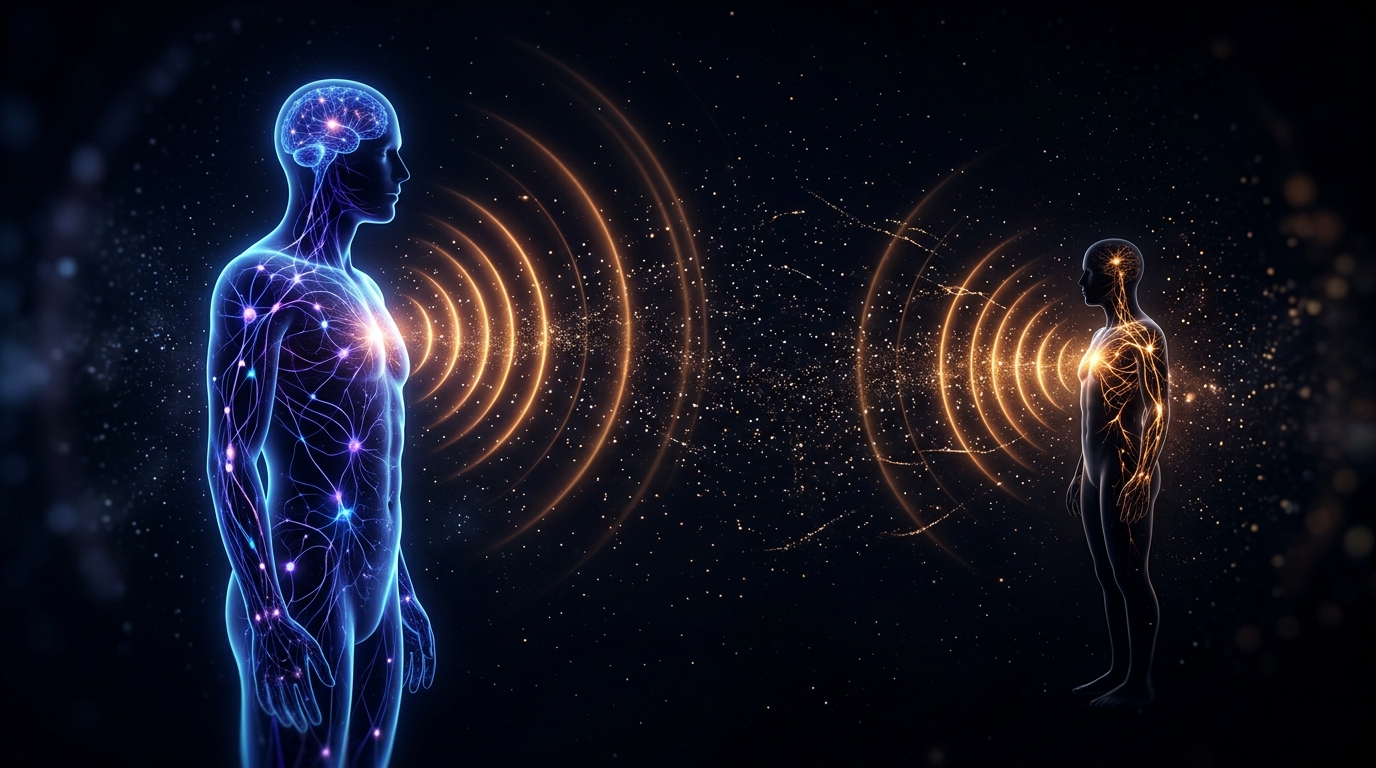
Most people think of body language as a performance. Something you 'do' — cross your arms, make eye contact, lean forward — to project a certain image. But that framing gets it exactly backwards.
Body language isn't a layer you put on top of communication. It is communication, at a level your nervous system was running long before language evolved. Understanding the psychology behind nonverbal cues changes how you show up in every conversation — not because you learn to fake signals, but because you finally understand what your brain and body are already doing without your permission.
This is the science of what your body communicates before you speak, and it's more fascinating — and more consequential — than most communication advice acknowledges.
The Neuroscience Behind Nonverbal First Impressions
Here's the thing: your brain makes social judgments at a speed that should feel alarming.
Research on thin-slicing — the brain's ability to form accurate impressions from very brief exposures — suggests that people form initial judgments of trustworthiness, competence, and likability within the first few hundred milliseconds of seeing someone. Not minutes. Not seconds. Fractions of a second.
This isn't a flaw in human cognition. It's a deeply conserved survival mechanism. For most of human evolutionary history, correctly reading whether another person was friend or threat was a matter of life and death. The brain systems that handle this evaluation are ancient, fast, and largely automatic — which is precisely why they respond to nonverbal information long before your verbal processing has even gotten started.
And this is why body language in conversation psychology matters so much. You're not just communicating with words. You're running a parallel broadcast on a channel that your listener's brain is tuned to receive before they've consciously registered anything you've said.
How the Brain Processes Body Language Faster Than Speech
Language comprehension is relatively slow, as brain processes go. It requires multiple cortical regions to work in sequence — auditory processing, syntactic parsing, semantic interpretation. It takes time.
Nonverbal processing is different. Facial expressions, posture, and gesture are processed through subcortical pathways that bypass some of that slower cortical machinery entirely. The result: your conversational partner's brain has already formed an emotional response to your nonverbal presentation before their language centers have finished decoding your opening sentence.
The Amygdala's Role in Reading Threat and Trust
The amygdala is a small, almond-shaped structure deep in the brain's temporal lobe, and it's essentially your threat-detection system. It scans incoming sensory information — including visual information about other people's body language — for signals of danger or safety.
What makes the amygdala relevant to conversation psychology is its speed and its priority. When the amygdala detects a potential threat signal — a tense posture, an averted gaze, a microexpression of contempt — it can trigger a stress response before your conscious mind has registered anything unusual. You've experienced this: the feeling that something is 'off' about a conversation before you can articulate why.
The flip side is equally important. Open posture, relaxed facial muscles, and steady eye contact send signals the amygdala reads as 'safe' — reducing the other person's defensive arousal and making genuine connection more possible. Trust, at a neurological level, is partly a function of calming someone else's threat-detection system.
Mirror Neurons: Why You Unconsciously Mimic Others
In the early 1990s, neuroscientist Giacomo Rizzolatti and his colleagues at the University of Parma made a discovery that reshaped our understanding of social cognition. While studying motor neurons in macaque monkeys, they found a subset of neurons that fired not just when a monkey performed an action, but when it observed another performing the same action.
These mirror neurons, as they came to be called, appear to exist in humans too — and they're central to why body language is contagious. When you watch someone smile, neurons associated with smiling activate in your own motor cortex. When you see someone slump with defeat, your body begins to register that state as well.
This is the neurological basis for the unconscious mimicry you've probably noticed in deep conversation — people matching each other's postures, adopting similar gestures, synchronizing their breathing. It's not deliberate. It's your brain simulating the other person's internal state in order to understand them. (This is also why watching someone else wince in pain makes you flinch.)
For conversation, this has a direct implication: the nonverbal state you bring into an interaction doesn't just signal your mood — it actively induces a version of that mood in the people you're talking with.
The Mehrabian Myth: What '55% of Communication Is Nonverbal' Actually Means
If you've spent any time in communication training, you've almost certainly encountered the '7-38-55 rule': 7% of communication comes from words, 38% from tone of voice, and 55% from body language. It's cited constantly, presented as established science, and almost universally misapplied.
Here's what Albert Mehrabian's research actually showed. In two studies conducted in the 1960s, Mehrabian was investigating a very specific question: when someone receives inconsistent messages about feelings — where words, tone, and facial expression conflict — which channel do they believe? His findings suggested that in those conditions of inconsistency, nonverbal cues carried more weight in conveying emotional attitude.
Mehrabian himself has repeatedly clarified that his findings were never meant to apply to communication in general. They apply specifically to the communication of feelings and attitudes, and specifically in situations where verbal and nonverbal signals contradict each other. Applying the 7-38-55 rule to, say, a business presentation or a first date conversation is a fundamental misreading of the original research.
But here's what the myth gets right, even if the numbers are wrong: in emotionally loaded conversations — which most meaningful conversations are — nonverbal signals carry disproportionate weight. When someone says 'I'm fine' with a flat voice and closed posture, you don't believe the words. The psychology of nonverbal communication is most powerful precisely where it matters most: in conversations involving trust, emotion, and relationship.
Understanding this distinction matters if you want to start better conversations today with real psychological grounding rather than misquoted statistics.
Emotional Contagion: How Body Language Spreads Mood in a Conversation
Emotional contagion is the process by which emotions spread from person to person — and body language is its primary transmission mechanism.
The mechanism works through multiple channels simultaneously. Facial mimicry (driven partly by mirror neuron activity) causes you to unconsciously replicate another person's expression, which then generates the corresponding emotion in you through facial feedback. Postural mirroring does something similar with proprioceptive cues. Even breathing synchronization plays a role — couples and close friends often unconsciously match respiratory rhythms during conversation.
Social psychologists Elaine Hatfield and John Cacioppo, who formalized emotional contagion theory, found that people are continuously 'catching' emotions from others through these automatic mimicry processes. And the research suggests we're not equally susceptible — people who are more emotionally expressive tend to be stronger 'senders,' while more attentive individuals tend to be more susceptible 'receivers.'
For practical conversation purposes, this means the emotional state you enter a conversation with is not private. It radiates. A person carrying anxiety into a networking event doesn't just feel anxious — they make others around them subtly more anxious, often without anyone understanding why the interaction felt draining. Conversely, someone with genuine warmth and calm presence shifts the emotional register of a room. Not through charisma as some mystical quality, but through measurable neurological and physiological processes.
Cognitive Load and Body Language: Why Stress Leaks Through Your Posture
Cognitive load theory, developed by educational psychologist John Sweller, describes the limits of working memory — the idea that your brain can only consciously process a finite amount of information at once. When cognitive load is high (you're stressed, multitasking, or carefully managing what you say), something has to give.
What gives is usually your nonverbal self-regulation.
This is why people under stress or attempting deception show characteristic 'leakage' — micro-expressions, postural tension, reduced gesture fluency, irregular eye contact. The brain is spending its limited executive resources on managing the verbal output and simply doesn't have capacity left to also manage every physical signal. The body defaults to its honest state.
So the common advice to 'control your body language' is, in a real sense, neurologically misguided. You can't maintain deliberate physical self-management while also engaging fully in a cognitively demanding conversation. Something leaks.
The more effective approach — and this connects to what researchers studying authentic communication consistently find — is to manage your internal state rather than your surface signals. When you're genuinely calm, your posture reflects calm without effort. When you're genuinely interested, your attentiveness shows without performance. The body isn't something to control; it's something that reports.
How Awareness of These Psychological Mechanisms Makes You a Better Communicator
Knowing that your amygdala is reading threat signals, that mirror neurons are synchronizing emotional states, and that cognitive load causes nonverbal leakage changes what 'good communication' actually means.
It means that the goal isn't to perform confidence or warmth. It's to cultivate the internal conditions that generate those states authentically — because your brain will broadcast them anyway, and people's brains will receive them.
It also means that being a better listener has a neurological dimension. When you're genuinely attentive — not just performing attentiveness — your mirror neuron activity increases, your emotional attunement improves, and the person you're talking with literally feels more understood. This isn't metaphorical. It's measurable in physiological synchrony between conversation partners.
And it reframes what makes conversations go wrong. Many conversational failures aren't about the wrong words — they're about mismatched nonverbal states, threat signals triggering amygdala responses, or emotional contagion spreading anxiety through a group. Understanding the psychology of nonverbal communication means you can diagnose these failures more accurately and address them at the right level.
For a deeper look at how these signals operate from the very first moment of interaction, the guide on reading body language in conversation offers practical pattern recognition built on these same principles.
Applying the Psychology: Three Habits to Shift Your Nonverbal Impact
Given everything above, here are three habits grounded in the actual neuroscience — not performance tips, but practices that work with your brain's architecture rather than against it.
Practical Tactics
| Technique | Best Use | Outcome |
|---|---|---|
| Pre-conversation state regulation | Before high-stakes interactions (interviews, first meetings, difficult talks) | Reduces amygdala activation in both you and your conversation partner; lowers defensive arousal |
| Deliberate attentional focus on the other person | During conversations where you want to build rapport or trust | Activates mirror neuron synchrony; person feels genuinely heard rather than processed |
| Postural reset during cognitive load | When you notice tension building or a conversation getting difficult | Interrupts the stress-leakage cycle; signals safety to the other person's threat-detection system |
State regulation before conversation. Spend 60-90 seconds before a significant conversation doing something that genuinely shifts your internal state — slow breathing, a brief physical reset, recalling a moment of genuine connection. This isn't visualization theater. It's directly reducing cortisol and activating parasympathetic tone, which changes what your body broadcasts. Research on 'power posing' aside (that literature is contested), the underlying principle — that physical state affects psychological state and vice versa — is solid.
Attention as a nonverbal signal. The single most powerful nonverbal signal you can send is genuine attention. Not performed attention — actual, undivided focus on the person in front of you. This activates the mirror neuron systems that create felt understanding, and it's something people sense immediately and accurately. In my experience, most conversational awkwardness dissolves when one person commits to real attention rather than waiting for their turn to speak.
Using body language to anchor emotional states. Because of the bidirectional relationship between physical state and emotional state, you can use posture and breath deliberately — not to fake signals to others, but to shift your own internal experience. Open posture genuinely reduces cortisol. Slower breathing genuinely activates calm. These physical inputs change your neurological output. Understanding the difference between positive body language signals and performative ones is what separates effective communicators from people who've just memorized a list of tips.
The contrast between open and closed physical signals is worth understanding in depth too — the guide on open vs. closed body language in conversation breaks down what each configuration signals neurologically and how to read it in others.
Measuring What's Actually Working
How do you know if your nonverbal communication is landing differently? The metrics here aren't traditional, but they're real.
Watch for conversational reciprocity — are people matching your energy, sharing more, staying in the conversation longer? That's emotional contagion working in your favor. Watch for postural mirroring — when people unconsciously adopt similar positions to yours, it's a reliable indicator of rapport and mirror neuron synchrony. Notice response latency — when someone trusts and feels comfortable, their responses come more naturally, with less hesitation and self-editing.
And honestly, the clearest signal is internal: are you leaving conversations feeling energized rather than drained? When your nonverbal communication is authentic rather than performed, the cognitive load drops — and both you and your conversation partner feel the difference.
Where This Goes From Here
The science of body language in conversation psychology is still developing. Researchers are actively investigating how digital communication — video calls, text — changes the neurological dynamics of nonverbal processing. Early evidence suggests that the absence of full-body cues in video conversation increases cognitive load for both parties, which may partly explain why video calls feel more exhausting than in-person ones.
There's also growing research on interoception — the brain's awareness of internal body signals — and how it connects to social cognition. People with higher interoceptive awareness tend to be better at reading others' emotional states, suggesting that the path to better nonverbal communication runs through self-awareness as much as social skill.
What seems increasingly clear is that the old model — communication as information transfer, with body language as optional decoration — is simply wrong. Communication is a full-body, full-brain neurological event, happening at multiple levels simultaneously, most of them below conscious awareness.
Understanding that changes the question. It's not 'how do I appear confident?' It's 'what internal state generates the signals that build trust?' Not 'how do I read body language?' but 'how do I become genuinely attentive enough that my brain does the reading automatically?'
Those are harder questions. But they're the right ones. Start with the neuroscience, apply it honestly, and the conversations that follow will be different — because you'll be different walking into them. If you're ready to put this into practice, start better conversations today with a foundation that actually reflects how human brains work.