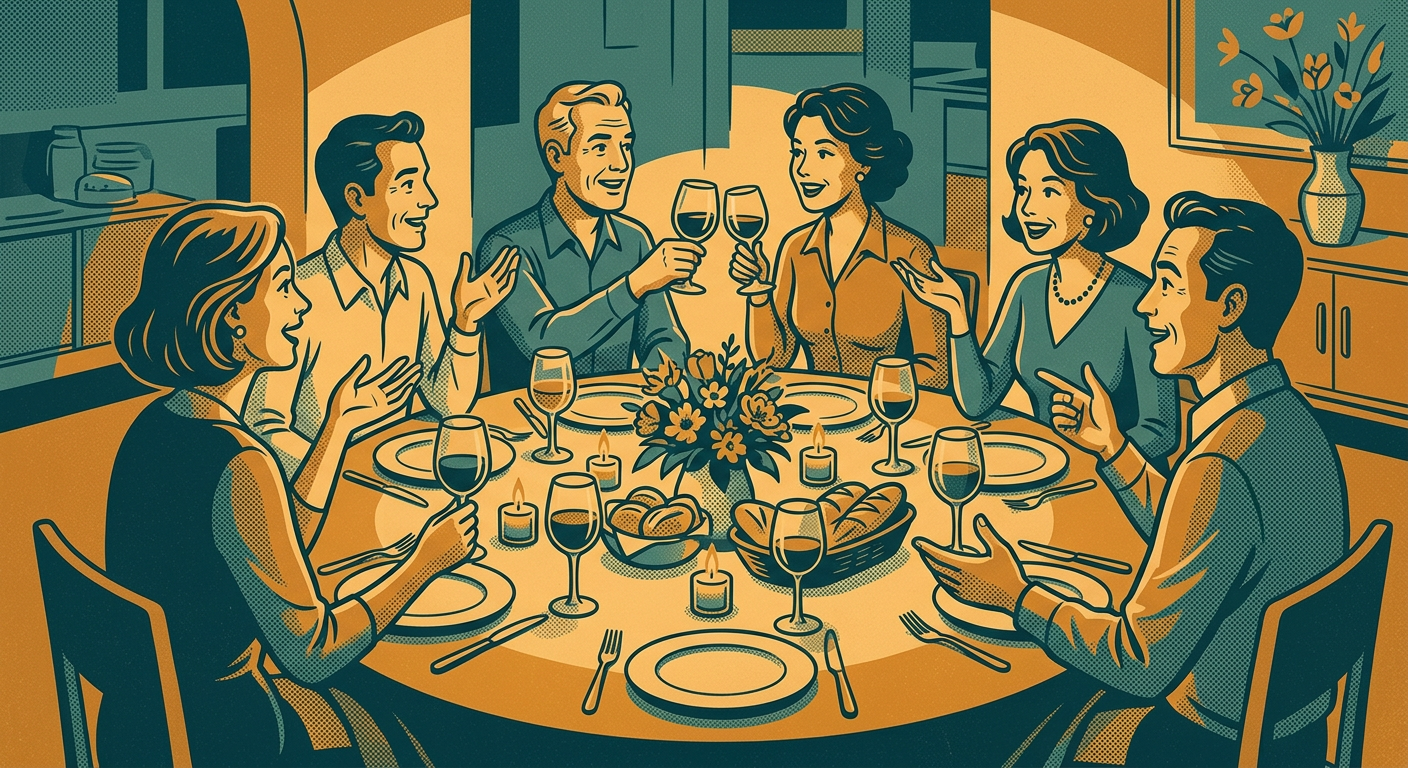
Picture this. You're fifteen minutes into a dinner party, and the table has split into two parallel conversations — one end talking about real estate, the other about a TV show you haven't watched. The host looks slightly panicked. Someone makes a joke that doesn't land. And then that particular silence settles in, the one where everyone suddenly finds their wine glass very interesting.
This is exactly the scenario that better conversation preparation prevents.
Finding the best group conversation starters for adults isn't about memorizing a list of clever questions. It's about understanding which questions fit which rooms — and having enough of them ready that you're never caught flat-footed. Whether you're hosting a dinner party, showing up to a casual gathering, or navigating a professional social event, the right opener changes everything.
What Makes a Group Conversation Starter 'Best' for Adult Social Settings
The Criteria: Inclusive, Low-Pressure, and Repeatable
Not all conversation starters are built the same. A question that works brilliantly in a college dorm would get blank stares at a 40th birthday dinner. The best starters for adult social settings share three qualities.
First, they're inclusive — meaning anyone in the group can answer without needing specialized knowledge, a particular political view, or a personal story they may not want to share. Second, they're low-pressure — they don't put one person on the spot as the "performer" while everyone else watches. Third, they're repeatable — you can use them across multiple events without them feeling stale, because the answers are always different.
So, a question like "What's the most interesting thing you've done in the last year?" checks all three boxes. A question like "What's your take on the current political situation?" fails the inclusive test immediately.
How Social Events Differ From Other Group Contexts
Adult social events have a specific dynamic that separates them from, say, workplace team meetings or classroom icebreakers. The stakes feel personal but not professional. People want to enjoy themselves, not perform. And critically, there's no facilitator with institutional authority — the conversation opener has to earn its place through social fluency, not hierarchy.
This is why the broader skill of group conversation skills for social leaders matters so much here. You're not running a meeting. You're creating a moment where multiple adults, with different backgrounds and comfort levels, choose to engage together.
Top Group Conversation Starters for Dinner Parties
Openers That Work Around a Table
Dinner parties have a natural structure that works in your favor: everyone's seated, everyone's facing each other, and there's a shared focal point (the meal, the host, the occasion). This structure allows for sequential sharing — one person answers, which prompts the next, which builds genuine momentum.
Here are starters that consistently work around a dinner table:
- "What's something you've changed your mind about in the last few years?" — This invites reflection without requiring vulnerability. It signals intellectual openness, which sets a generous tone for the whole evening.
- "If you could have dinner with anyone from history — not famous for being famous, but genuinely historically significant — who would it be and why?" — The added qualifier prevents the predictable celebrity answers and makes people actually think.
- "What's the best meal you've ever had, and what made it memorable?" — At a dinner table, this is contextually perfect. Food is safe, sensory, and everyone has a story.
- "What's something you've recently discovered that you wish you'd known ten years ago?" — Works especially well with mixed-age groups because the answers reveal generational differences in a non-confrontational way.
Questions That Invite Everyone Without Putting Anyone on the Spot
The danger at dinner parties is the question that accidentally turns into an interrogation of one person. You want a question where the first answer naturally invites others to share their own version.
Framing matters here. Instead of "Tell us about yourself," try "What's everyone working on right now that they're actually excited about?" The plural framing signals that this isn't a one-person spotlight — it's a round.
And if someone at the table is quieter, a good host can gently extend: "I'd love to hear your take on that too" — not as pressure, but as genuine invitation.
Top Group Conversation Starters for Parties and Casual Gatherings
High-Energy, Low-Stakes Openers for Mingling Crowds
Casual parties are a different animal entirely. People are standing, moving, forming and reforming clusters. The conversation starter here doesn't need to hold a group of ten together — it needs to ignite a two-to-four person conversation that can evolve organically.
For these settings, try:
- "What's your most controversial food opinion?" — Absurdly effective. Everyone has one, it's meaningless enough to be safe, and the disagreements it sparks are purely fun.
- "What's something you've been obsessed with lately?" — Open-ended, enthusiasm-inviting, and it reveals personality without requiring personal history.
- "If this party had a theme song, what would it be?" — Situationally grounded, slightly silly, and it immediately creates shared laughter.
- "What's the best piece of advice you've ever ignored?" — A little self-deprecating, which puts everyone at ease.
For more ideas calibrated to casual group settings, the group conversation starters for adults resource has a broad library organized by social context.
Questions That Create Natural Subgroup Conversations
At larger parties, the goal isn't one big group conversation — it's seeding multiple good conversations simultaneously. Here's the thing: the best way to do this is to ask a question and then step back. Let it breathe. If you've asked something genuinely interesting, people will start talking to the person next to them, not just responding to you.
Questions that spark lateral conversation (person-to-person, not just person-to-host) tend to be comparative or preference-based: "Would you rather" framings, "best vs. worst" formats, or "what's your take on X" questions that invite mild debate.
Looking for starters specifically designed for group text threads and digital social gatherings? Group conversation starters for texting and group chats covers that territory in detail.
Top Group Conversation Starters for Formal or Semi-Formal Adult Events
Professional Socials and Networking Mixers
Formal events require a different calibration. People are often there for professional reasons, which means they're more guarded — but also more motivated to connect meaningfully. The best starters here bridge the professional and personal without being intrusive.
- "What's a project or initiative you're working on that you're genuinely proud of?" — More specific than "what do you do" and invites enthusiasm rather than job-title recitation.
- "What brought you to this particular event tonight?" — Simple, but the answers reveal intent and create natural follow-up threads.
- "What's something you've learned recently that surprised you?" — Works across industries and seniority levels.
For a deeper look at professional social contexts specifically, the techniques in networking small talk for professional settings are worth reviewing before any mixer.
Celebrations and Milestone Events
Weddings, milestone birthdays, retirement parties — these events have a built-in anchor: the person or occasion being celebrated. Use it.
- "What's your favorite memory with [person being celebrated]?" — Instantly warm, relevant, and it gives quieter guests an easy entry point.
- "What do you think is the secret to [what's being celebrated — a long marriage, a successful career]?" — Invites reflection and generates surprisingly varied, thoughtful answers.
- "How did you end up knowing [host/guest of honor]?" — Classic for a reason. The connection stories are always interesting.
How to Deliver a Conversation Starter So It Actually Lands
Timing, Tone, and Body Language When Opening a Group
Here's a truth most advice skips: a mediocre question delivered with warmth and confidence outperforms a brilliant question mumbled into the middle of a loud room.
Timing is everything. Wait for a natural lull — not a tense silence, but a conversational exhale. That moment when one thread has wound down and people are looking around. That's your window.
Tone should be curious, not performative. You're not hosting a game show. You're genuinely interested in what people think. If you ask a question like you actually want to know the answer, people feel that.
Body language amplifies or undermines your opener. Open posture, eye contact that sweeps the group (not locked on one person), a slight lean forward — these signal that you're inviting participation, not demanding it. For a detailed breakdown of how physical presence shapes conversation before you even speak, body language and conversation openers is worth reading.
And don't forget: you answer first, briefly. Model the depth you want. A one-sentence answer invites one-sentence answers. A two-minute monologue kills the room. Aim for thirty seconds — enough to show genuine engagement, short enough to hand the floor to someone else.
Quick-Reference: 15 Vetted Starters Organized by Event Type
| Event Type | Conversation Starter |
|---|---|
| Dinner Party | What's something you've changed your mind about recently? |
| Dinner Party | What's the best meal you've ever had? |
| Dinner Party | What's something you wish you'd known ten years ago? |
| Dinner Party | If you could have dinner with anyone from history, who would it be? |
| Dinner Party | What's something you're quietly proud of this year? |
| Casual Party | What's your most controversial food opinion? |
| Casual Party | What have you been obsessed with lately? |
| Casual Party | What's the best piece of advice you've ever ignored? |
| Casual Party | What's something you've recently started doing that you love? |
| Casual Party | If this party had a theme song, what would it be? |
| Formal/Networking | What's a project you're genuinely proud of right now? |
| Formal/Networking | What brought you to this event tonight? |
| Formal/Networking | What's something you've learned recently that surprised you? |
| Celebration | What's your favorite memory with [person being celebrated]? |
| Celebration | What do you think is the secret to [what's being celebrated]? |
For a broader collection of starters designed specifically to get everyone talking at once, how to start a group conversation everyone joins offers practical openers with facilitation notes.
Final Recommendation: Match the Starter to the Moment
The single most common mistake people make with conversation starters is using the right question in the wrong room. A deeply reflective question about life changes lands beautifully at an intimate dinner for six. It feels weirdly heavy at a loud birthday party where people are still arriving.
In my experience, the people who are consistently good at opening group conversations don't have a magic personality trait — they've just thought about this more than everyone else. They arrive with two or three starters ready for the specific event they're walking into. They read the room for the right moment. And they ask with genuine curiosity, not as a social performance.
So before your next event, do this: identify the event type (dinner, casual party, formal mixer, celebration), pick two starters from the relevant category above, and have them ready. You don't need to use them. But having them removes the anxiety — and that confidence alone changes how you show up.
The conversation won't manage itself. But with the right starter, it barely needs to.