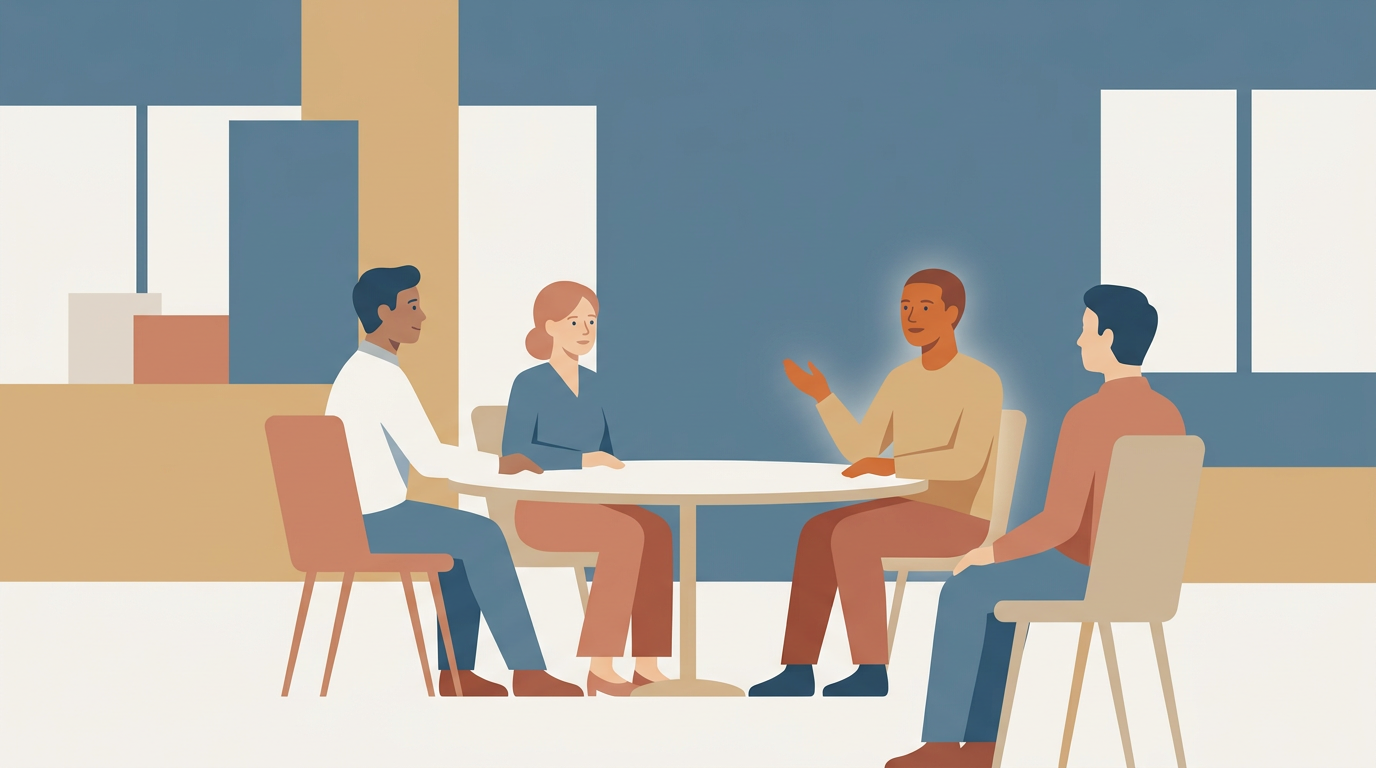
Most workplace advice treats shyness like a switch you can flip. 'Just speak up.' 'Put yourself out there.' 'Fake it till you make it.' If you're shy at work, you've heard all of it — and you know it doesn't work that way.
The professional environment creates a specific kind of social pressure that a dinner party or a neighborhood cookout simply doesn't. Your income, your reputation, your career trajectory — they're all in the room when you're deciding whether to raise your hand in that meeting. That's not irrational fear. That's an accurate read of the stakes.
But here's the thing: you don't need a personality overhaul to build genuine confidence at work. What you need are targeted, low-risk habits that gradually expand your comfort zone — without asking you to become someone you're not. This article gives you exactly that.
If you're working on shyness more broadly, start with the foundation: how to stop being shy in conversations. But if the workplace specifically is where the walls go up, keep reading.
Why Shyness Hits Differently in Professional Settings
The Stakes Feel Higher: Why Work Triggers Social Anxiety More Than Social Settings
At a social gathering, saying something awkward costs you mild embarrassment. At work, it can feel like it costs you credibility — with your manager, your team, your career.
This perceived consequence gap is real. Research on workplace communication consistently shows that employees rate professional interactions as significantly more anxiety-provoking than personal social situations. The evaluation threat is constant: your ideas are assessed, your contributions are tracked, and your silence is noticed.
And the environment reinforces it. Meetings have hierarchies. Performance reviews create permanent records. One clumsy comment in front of the wrong person can sit in your mind for weeks. So the nervous system responds accordingly — heart rate up, voice tightens, mind goes blank at the worst possible moment.
This isn't weakness. It's your brain running a threat assessment that happens to be miscalibrated for the actual risk.
The Difference Between Being Shy and Being an Introvert at Work
Susan Cain's landmark book Quiet brought introversion into mainstream conversation — and that was genuinely valuable. But it also created a conflation that causes problems: people started using 'shy' and 'introvert' as synonyms. They're not.
Introversion is about energy. Introverts recharge in solitude and find prolonged social interaction draining. It says nothing about fear.
Shyness is about anxiety. It's the uncomfortable self-consciousness and inhibition that shows up in social situations — the fear of negative evaluation, of saying the wrong thing, of being judged.
You can be an extrovert who's shy (loves people, terrified of rejection). You can be an introvert who's not shy at all (prefers solo time, but confident when engaged). Many people at work are both introverted and shy, which creates a double challenge: they're drained by the social environment and anxious within it.
Knowing which you're dealing with matters because the solutions are different. An introvert might need to protect energy and choose interactions strategically. A shy person needs to work on the fear response itself — through gradual exposure and low-risk practice.
The Hidden Cost of Staying Quiet at Work
Missed Opportunities: Promotions, Projects, and Visibility
Look, this is the part nobody wants to say bluntly: staying silent at work has a career cost.
Visibility matters in most organizations. Managers promote people they can see thinking. Project leads invite contributors they've heard speak. Senior stakeholders remember the person who asked the sharp question in the all-hands, not the one who typed a question into the chat and deleted it before sending.
A 2023 survey by LinkedIn found that 85% of jobs are filled through networking and professional visibility — not just applications. Your ability to be seen, heard, and remembered is a career asset with measurable value.
This isn't about being the loudest person in the room. It's about being present in the room in a way that registers.
How Silence Gets Misread by Colleagues and Managers
Here's what's unfair but true: people don't know what you're thinking. They see behavior.
Quietness in meetings gets interpreted as: lack of preparation, disengagement, low confidence, or agreement by default. None of those may be accurate. But perception drives decisions — who gets cc'd on emails, who gets invited to strategy discussions, who gets considered for stretch assignments.
Managers, especially those who lean extroverted themselves, often misread quiet competence as absence of ideas. I've seen this pattern repeatedly in organizations: the shyest person on the team doing the best work, invisible at review time because they never signaled what they knew.
This isn't about performing for others. It's about making sure your actual value gets seen.
Practical Strategies to Stop Being Shy at Work
Start With One-on-One Conversations Before Group Settings
Group settings are the hardest place to start. So don't start there.
One-on-one conversations are lower stakes, more reciprocal, and easier to control. They build the familiarity that makes group interactions less threatening — because when you speak up in a team meeting, you're no longer speaking to strangers.
Practical steps:
- Schedule brief check-ins with colleagues you work alongside but rarely talk to directly.
- Use existing transitions — before a meeting starts, after it ends, in the kitchen. Low-commitment, natural, no agenda required.
- Ask one specific question rather than trying to maintain a full conversation. 'What did you think of the feedback on that proposal?' is manageable. Open-ended networking small talk is exhausting.
For those who struggle with how to open these conversations without it feeling forced, conversation starters for professional settings can give you concrete language that doesn't sound scripted.
Use Preparation as a Confidence Scaffold in Meetings
Preparation is the single most underused tool for shy professionals.
Most people walk into meetings underprepared and hope they'll have something to contribute when the moment arises. For shy people, that hope rarely pays off — because anxiety blocks real-time access to your own thoughts.
So prepare specific contributions before every meeting:
- Write down one question you could ask.
- Identify one observation you could share.
- Know one piece of relevant context you could add.
You don't need to use all of them. But having them written down removes the 'blank mind' problem. When the opening appears, the words are already there.
This also works because preparation shifts your focus outward. Instead of monitoring how you're coming across, you're tracking the conversation for the moment your prepared point fits. That's a much more manageable cognitive task.
The 'First Comment' Rule: Why Speaking Early Changes Everything
This is backed by both psychology and practical experience: the longer you wait to speak in a meeting, the harder it gets.
Every minute you stay silent, the internal barrier grows. You start pre-screening your contributions more aggressively. You talk yourself out of things. The window closes.
The solution: commit to saying something — anything appropriate — within the first few minutes of a meeting.
It doesn't have to be brilliant. A brief observation, a clarifying question, even a short acknowledgment of a colleague's point. The content matters less than the act of speaking. Once you've spoken once, the second time is measurably easier. The third time, easier still.
And here's the thing — early comments get disproportionate attention. Research on meeting dynamics shows that people who speak early in discussions are perceived as more confident and engaged, regardless of the quality of the contribution. First impressions within a meeting are formed fast.
How to Build Workplace Relationships Without Forced Small Talk
Many shy people dread small talk — not because they're antisocial, but because the stakes feel high and the content feels meaningless. (Honestly, a lot of extroverts feel the same way and just hide it better.)
The solution isn't to force yourself through meaningless pleasantries. It's to replace them with genuine micro-conversations.
- Specific over generic. 'How was your weekend?' is hard to answer interestingly. 'Did that client call end up going okay?' is specific, shows you were paying attention, and invites a real response.
- Observation-based openers. 'I noticed the timeline on the project shifted — is that affecting your part of it?' These require no small talk skill whatsoever and tend to produce meaningful exchanges.
- Follow up on previous conversations. If someone mentioned something last week, referencing it shows you listened. That single act builds more rapport than ten minutes of generic chat.
For more frameworks on keeping workplace conversations going beyond the opening exchange, why your conversations die after 90 seconds has practical techniques that work in professional contexts.
| Technique | Best Use | Outcome |
|---|---|---|
| Prepare 1 question before meetings | Weekly team meetings, project updates | Reduces blank-mind anxiety, increases contribution rate |
| First Comment Rule | Any group meeting, especially with senior stakeholders | Lowers internal barrier, improves perceived engagement |
| One-on-one check-ins | Building relationships with new colleagues or managers | Creates familiarity that reduces group anxiety |
| Specific follow-up questions | Post-meeting conversations, hallway exchanges | Builds rapport without forced small talk |
| Written pre-contribution | Async communication, Slack, email | Builds confidence through low-risk visible contribution |
| Body language anchoring | High-stakes presentations, performance conversations | Signals confidence before words do |
When Shyness at Work Is Actually Social Anxiety: Knowing the Difference
Shyness is uncomfortable. Social anxiety is impairing.
If you feel nervous before presenting and relieved after — that's shyness. If you're avoiding meetings entirely, calling in sick to dodge presentations, or spending hours after workplace interactions in a cycle of rumination — that's worth taking seriously as social anxiety.
The clinical distinction matters because the interventions are different. Shyness responds well to gradual exposure and practiced habits. Social anxiety — which affects roughly 12% of adults at some point in their lives — often benefits from professional support, including cognitive behavioral therapy (CBT), which has strong evidence behind it.
If you're unsure whether you're dealing with shyness or something more clinical, the article overcoming shyness: self-help vs. therapy breaks down how to tell the difference and what to do about each.
The key question: is the discomfort occasional and manageable, or is it consistently preventing you from doing things you need or want to do? One is a habit to build. The other deserves real support.
Long-Term Habits That Build Lasting Confidence in Professional Conversations
Confidence isn't a trait you either have or don't. It's a result — of repeated actions that work.
Here's what actually builds professional confidence over time:
Micro-contributions, consistently. Don't wait for the perfect moment to speak up. Speak up imperfectly, often. Each small act of contribution rewires the neural association between speaking up and catastrophe — because the catastrophe doesn't happen.
Track what works. Most shy people track what went wrong. Start tracking what went right. The meeting where you asked a question and someone said 'great point.' The one-on-one where a colleague opened up after you asked something specific. These instances matter and they're easy to forget.
Build your visible record. If speaking in meetings feels too high-stakes initially, start building visibility through written contributions — thoughtful Slack messages, well-framed emails, detailed project updates. These create a record of your thinking that others can reference, and they build your confidence in your own ideas before you voice them live.
Accept the discomfort as part of the process. Waiting until you feel confident to act is backwards. Action produces confidence, not the other way around. The discomfort of speaking up when you're shy doesn't mean you're doing it wrong — it means you're doing it.
For people working on shyness beyond the workplace, the approach to how to stop being shy as an adult applies the same principles across other social contexts.
And if making friends at work — not just professional acquaintances — is the real goal, how to stop being shy and make friends covers the relational side of this specifically.
Your Quiet Voice Still Has Value
Workplace confidence isn't about being louder. It's about being present — consistently enough that your competence becomes visible.
Start this week with one thing:
- Pick one upcoming meeting and write down a single question you'll ask.
- Ask it within the first ten minutes.
- Notice what happens.
That's it. One meeting, one question, one data point that your voice belongs in the room.
The strategies in this article don't ask you to perform extroversion or pretend the fear isn't there. They ask you to act in spite of it, incrementally, until the fear stops running the show.
Your ideas are already there. The goal is just making sure other people can see them too.