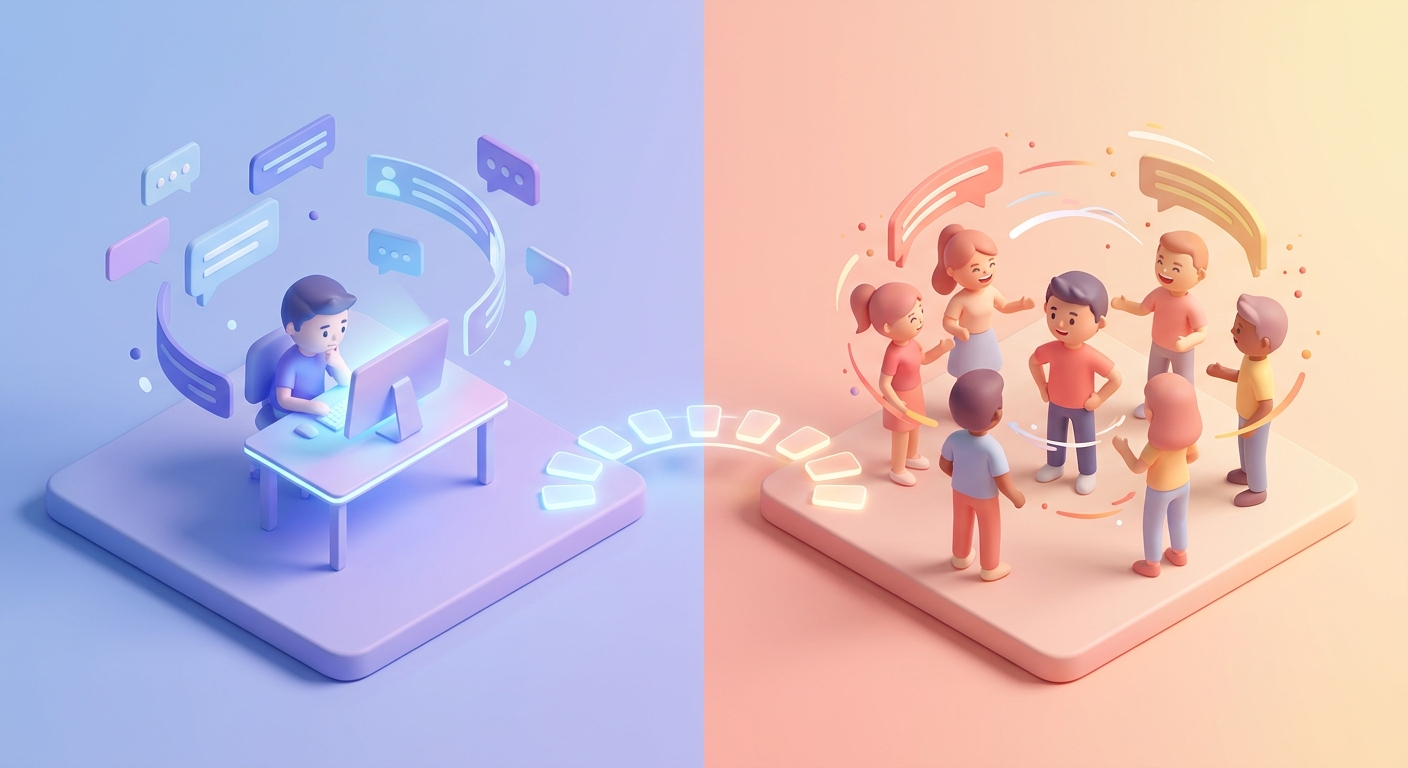
Why Passive Learning Alone Won't Fix Your Conversation Flow
Most people who want to get better at conversation do the same thing: they read articles, watch YouTube videos, maybe buy a book on social skills. They collect techniques. And then they walk into a real conversation and freeze up exactly as they always did.
Here's the thing — that's not a knowledge problem. It's a practice problem.
Conversation is a motor skill as much as a cognitive one. Think about learning to drive. Reading the highway code doesn't prepare you for merging onto a motorway at speed. You need reps. You need the feedback loop of real-time pressure, response, and correction. The same principle applies to the conversation flow techniques these tools are designed to help you practice.
Research on deliberate practice — the framework developed by psychologist Anders Ericsson — consistently shows that skill acquisition requires focused repetition with feedback, not passive exposure. Conversation habits formed over years don't dissolve from reading a listicle. They dissolve from doing something differently, repeatedly, until the new behavior becomes automatic.
So the question isn't 'what should I know about conversation?' The question is: 'what tool will give me the most useful reps for my specific weak point?'
That's what this guide is actually about.
What to Look for in a Conversation Practice Tool
Before we get into specific tools, it helps to have a framework for evaluating them. Not all practice is equal, and not all tools serve the same purpose.
Four criteria matter most:
Feedback quality — Does the tool tell you why something didn't work, or just that it didn't? Generic feedback produces slow improvement.
Stakes calibration — Zero-stakes practice (talking to an AI alone in your room) builds familiarity but not resilience. You need some social pressure to simulate real conditions.
Specificity to your weak point — Someone who struggles with initiating conversations needs different reps than someone who loses conversational thread after the first exchange.
Repetition frequency — Spaced repetition research suggests short, frequent sessions (10-15 minutes daily) produce faster skill consolidation than occasional long sessions. Any tool that doesn't fit into a daily routine will get abandoned.
With those in mind, here's how the major tools stack up.
AI-Powered Conversation Practice Tools
ChatGPT Role-Play Scenarios: Pros and Cons
ChatGPT has become one of the most versatile conversation practice tools available — not because it was designed for that, but because it's endlessly configurable. You can set up specific role-play scenarios: a first date, a networking event, meeting a new colleague. You can ask it to play a difficult conversational partner — someone who gives short answers, or someone who dominates the conversation.
The real advantage is volume and zero judgment. You can practice the same scenario twenty times in a row without social embarrassment. For people working on keeping conversations going over text, ChatGPT text role-play is a particularly low-friction entry point.
But there's a meaningful limitation: ChatGPT is cooperative by default. It wants the conversation to succeed. Real conversations involve people who are distracted, uninterested, or socially awkward themselves. You have to explicitly prompt ChatGPT to be difficult, and even then it tends to soften after a few exchanges. The social pressure that makes conversation genuinely hard simply isn't there.
Best for: Building response fluency, practicing specific scenarios, working on open-ended question habits.
Not ideal for: Developing resilience to awkward silences or learning to read non-verbal cues.
Replika: Emotional Conversation Practice
Replika markets itself as an AI companion, which sounds gimmicky until you realize what it actually provides: a space to practice emotionally honest conversation without social consequences. For people who struggle with vulnerability or emotional depth in conversation, Replika offers a genuinely different kind of rep.
The app uses a memory system that tracks previous conversations, which creates a more continuous relationship than ChatGPT's session-based interactions. It's designed to respond empathetically and to ask follow-up questions, which trains the reciprocal rhythm of real dialogue.
The limitation is similar to ChatGPT's: Replika is engineered to be warm and validating. It won't challenge you the way a real person will. (It's also worth noting that Replika's business model has shifted over time, with some features moving behind a subscription paywall — worth checking current pricing before committing.)
Best for: People who feel anxious about emotional self-disclosure, or who want to practice vulnerability in conversation.
Not ideal for: Building tolerance for conversational friction or rejection.
Speeko: Structured Speaking Confidence App
Speeko takes a different approach entirely. Rather than simulated dialogue, it offers structured speaking exercises — daily prompts that you speak aloud, timed responses, and coaching on delivery. Think of it as a gym for verbal fluency.
The app is particularly useful for people whose conversation problem is upstream of flow: they struggle with articulation, pacing, or filler word habits before they even get to the challenge of sustaining dialogue. Speeko addresses those foundational issues systematically.
Pricing sits around $8-10/month, which makes it one of the more affordable structured options. The exercises are short enough to fit into a morning routine, which helps with the consistency problem.
Best for: Verbal fluency, reducing filler words, building speaking confidence before high-stakes conversations.
Not ideal for: Practicing the back-and-forth dynamic of actual dialogue.
Real-World Practice Frameworks That Beat Any App
The Toastmasters Table Topics Method
Toastmasters gets mentioned constantly in public speaking circles, but its Table Topics format is specifically undervalued as conversation flow training. Table Topics is a segment where members are given a random question or prompt and must speak for 1-2 minutes on the spot, with no preparation.
And that's exactly the skill most people lack in conversation: spontaneous, coherent response under mild social pressure.
Toastmasters meetings are free to attend as a guest in most chapters, and membership costs roughly $45-50 every six months depending on the chapter. For the price of one mediocre app subscription, you get real humans, real stakes, and structured feedback from people who've been practicing longer than you.
The research on deliberate practice consistently finds that feedback from experienced practitioners accelerates improvement faster than self-evaluation alone. Toastmasters provides exactly that.
Best for: Spontaneous response fluency, managing conversation anxiety in social settings, getting structured human feedback.
Improv Classes as Conversation Flow Training
Improv comedy is, at its core, a training system for conversational responsiveness. The foundational 'yes-and' principle — accepting what your partner offers and building on it — is a direct model for how yes-and techniques compare to open questions as tools for sustaining dialogue.
A six-week beginner improv course typically costs $150-250 depending on the city and school. That's more expensive than an app, but the ROI is different. Improv forces you to practice presence, listening, and spontaneous response simultaneously — with other real humans who are also slightly uncomfortable. That combination is nearly impossible to replicate digitally.
Many people who take improv classes report that the biggest shift isn't in their comedy skills — it's in their willingness to follow conversational threads wherever they lead, without needing to control the outcome.
Best for: Conversational spontaneity, listening skills, reducing the need to 'plan' what to say next.
Low-Tech Tools That Still Deliver Results
Journaling Conversation Replays
This one sounds too simple to work. It isn't.
After a conversation that didn't go the way you wanted — or one that went surprisingly well — write it out from memory. What did you say? What did they say? Where did the energy drop? What question could you have asked instead?
This is a form of deliberate practice that forces pattern recognition. Over time, you'll start to notice your conversational habits: the topics you avoid, the moments you deflect, the types of questions you never think to ask. No app surfaces that kind of personalized insight.
For anyone working on conversation flow techniques when talking to someone they like, journaling replays are particularly useful for identifying anxiety-driven patterns that are otherwise invisible in the moment.
The Mirror Drill for Self-Monitoring
Speak aloud to yourself in a mirror for five minutes on any topic. No script. The goal isn't to sound good — it's to observe yourself. Most people are shocked by what they see: the filler words, the downward inflection at the end of every sentence, the lack of eye contact even with their own reflection.
The mirror drill builds self-monitoring capacity, which is the meta-skill underlying all conversation improvement. You can't fix what you can't observe.
Our Recommended Practice Stack by Goal
| Your Weak Point | Primary Tool | Secondary Tool |
|---|---|---|
| Initiating conversations | ChatGPT role-play (scenario practice) | Conversation starters to use during your practice sessions |
| Sustaining conversational flow | Toastmasters Table Topics | Journaling replays |
| Emotional depth / vulnerability | Replika | Journaling replays |
| Verbal fluency / filler words | Speeko | Mirror drill |
| Spontaneous response | Improv classes | ChatGPT difficult-partner prompts |
| Conversation anxiety | Toastmasters (guest attendance first) | Speeko (confidence baseline) |
So here's the honest recommendation: pick one digital tool and one real-world framework, and commit to both for 30 days. The digital tool gives you volume and low-stakes reps. The real-world framework gives you authentic pressure. Neither alone is sufficient.
Frequently Asked Questions
Can I actually improve conversation skills with an app? Yes, with an important caveat. Apps build familiarity and fluency in low-stakes conditions. But real conversation involves social pressure, non-verbal cues, and unpredictability that no current app fully replicates. Apps are training wheels — useful, but not the destination.
How long does it take to see improvement? With consistent daily practice (15-20 minutes), most people notice behavioral shifts within 3-4 weeks. But 'improvement' is nonlinear — you'll often feel worse before you feel better, because increased self-awareness surfaces habits you didn't notice before.
Is Replika worth paying for? For emotional conversation practice specifically, the free tier covers most use cases. The paid tier ($15-20/month depending on plan) unlocks more relationship-style features that aren't necessary for skill-building purposes.
What if I don't have time for Toastmasters or improv? Start with the mirror drill and journaling replays — both require zero scheduling and deliver real results. Then add one social rep per week: a slightly longer conversation with a barista, a follow-up question to a colleague. Volume doesn't have to come from formal programs.
Do these tools work for text-based conversation too? Most of the principles transfer. ChatGPT role-play is actually better suited to text conversation practice than voice. For a deeper look at text-specific techniques, the principles around keeping conversations going over text apply directly to how you'd structure your ChatGPT practice scenarios.
The most important shift you can make isn't downloading a new app. It's deciding that conversation is a skill you can actually practice — not a fixed personality trait you're stuck with. Pick one tool from this list that matches your specific weak point. Use it for two weeks before evaluating. That's the practical next step.