You're at a networking event. You've introduced yourself, exchanged names, and now there's that three-second gap where one of you has to say something. Most people fill it with "So, what do you do?" And just like that, you've triggered the most predictable, least memorable exchange in professional life.
Here's the thing: the problem isn't small talk. The problem is using low-quality questions at the wrong moment. The 7 best questions to ask while networking aren't just interesting — they're strategically timed, and knowing which one to deploy at which stage of a conversation is what separates people who leave events with real connections from those who leave with a stack of business cards they'll never use.
This isn't a cheat sheet. It's a system.
Why Most Networking Questions Are Forgettable (And How to Fix That)
The Problem With 'What Do You Do?'
"What do you do?" seems harmless. But from a conversational psychology standpoint, it's a closed trigger. It activates a person's professional persona — the polished, rehearsed version they present to strangers. You get a job title. Maybe a company name. You don't get a person.
Research published in the Journal of Personality and Social Psychology found that people who ask more questions — particularly follow-up questions — are rated as significantly more likeable by their conversation partners. But most networkers never get to follow-up questions because their opening question generated a one-sentence answer that went nowhere.
The fix isn't to avoid professional topics. It's to approach them from an angle that invites a story rather than a summary.
What Makes a Networking Question Actually Memorable
Three things, specifically:
Narrative pull — the question should invite a story, not a data point. Stories create emotional memory. Data doesn't.
Psychological safety — the question shouldn't feel like an evaluation. Dale Carnegie spent an entire book explaining that people become genuinely engaged when they feel heard and valued, not assessed.
Reciprocity hooks — the best questions implicitly invite the other person to ask something back, creating a real exchange rather than an interview. The reciprocity principle (the social norm that we respond to what others give us) means a thoughtful question often earns a thoughtful question in return.
For a broader foundation on this, the parent guide on what to say at networking events beyond small talk covers how to build the conversational scaffolding these questions fit into.
The 7 Best Questions to Ask While Networking
Question 1: The Origin Story Opener
"How did you end up in [field/role]?"
This is your opening move. It's professional but personal, and it almost always generates a story rather than a title. Nobody's career path is a straight line (seriously — ask enough people and you'll find a chef-turned-marketer, a lawyer-turned-UX designer). The question signals genuine curiosity and gives the other person permission to be interesting.
Psychologically, origin stories activate autobiographical memory, which is emotionally rich. People feel more engaged when they're accessing meaningful memories rather than reciting facts.
Question 2: The Future-Focused Probe
"What are you most excited about in your work right now?"
This is your bridge from past to present-future. It shifts the conversation from what someone has done to what they care about, which is where real connection happens. It's also inherently positive — you're asking about excitement, not obligation.
In my experience running growth campaigns that required building media and partner relationships fast, this question was a consistent unlock. People who seemed guarded would light up when asked what they were excited about. Energy is contagious, and this question finds it.
Question 3: The Challenge Reveal
"What's the hardest part of what you're working on right now?"
This is a middle-phase question and it's deliberately vulnerable. By asking about difficulty, you're signaling that you're not just there to collect impressive information — you're genuinely interested in the reality of someone's work. This activates the reciprocity principle in a powerful way: real questions earn real answers.
A note on timing: don't deploy this in the first 60 seconds. It needs the psychological safety that Question 1 and 2 have already built. Used too early, it can feel presumptuous. Used at the right moment, it's the question people remember you for.
Question 4: The Unexpected Path Question
"What's something about your work that most people outside your field don't understand?"
This is one of the most underused thought-provoking networking questions in professional settings. It gives people permission to share expertise without bragging, and it positions you as someone worth educating — which is genuinely flattering. Most professionals have a pet frustration about misconceptions in their field. This question hands them the microphone.
It also generates highly specific, memorable content. You'll learn something real. And people who teach you something tend to remember you positively (again, reciprocity — you've given them the gift of being heard as an expert).
Question 5: The Insight Exchange
"I've been thinking a lot about [relevant trend/topic] — what's your take on it from where you sit?"
This question does something the others don't: it establishes you as a thinking person, not just an interested listener. You're contributing a perspective and inviting theirs. This is where the conversation becomes a genuine exchange rather than an interview.
The key is the phrase "from where you sit" — it acknowledges that their vantage point is unique and valuable. That's active listening made explicit, and it matters.
For students or early-career professionals adapting these questions, networking conversation starters for students has specific language that fits contexts where you have less industry experience to draw on.
Question 6: The Mutual Value Finder
"Is there anything I can help you with, or anyone I should connect you to?"
Most networking advice focuses entirely on what you can extract from a conversation. This question flips that. And it works for a specific reason: most people don't ask it, so it's memorable. But more importantly, it activates the reciprocity principle in reverse — offering value first makes the other person want to reciprocate.
This is a closing-phase question. It signals that you've been listening, that you're thinking about their needs, and that you're someone worth staying in contact with. According to a 2023 LinkedIn survey, 70% of people were hired at a company where they had a connection — which means the relationship-building function of networking has direct economic value. Generosity is strategy.
Question 7: The Memorable Close
"What would be the most useful thing to keep in touch about?"
This is the question that makes follow-up natural rather than awkward. Instead of the vague "let's connect!" that everyone says and nobody acts on, this question creates a specific thread. It tells the other person you're thinking about a real ongoing relationship, not just a LinkedIn connection.
It's also the question that reveals whether there's genuine mutual interest. If someone answers with something specific, you've found a real connection point. If they deflect, that's useful data too.
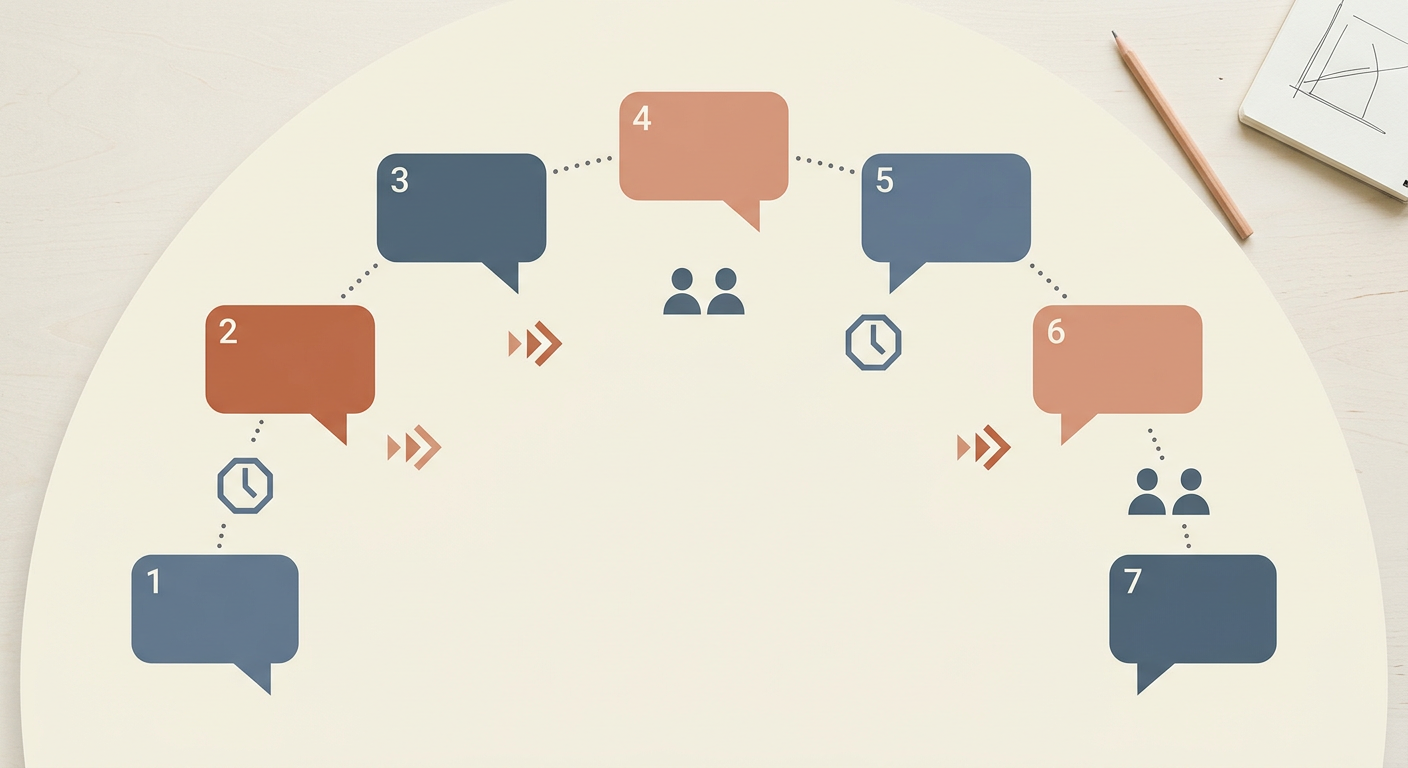
When to Use Each Question: Mapping Questions to Conversation Stages
| Question | Stage | Why It Works Here |
|---|---|---|
| Origin Story Opener | Opening (0–60 sec) | Activates narrative, low pressure |
| Future-Focused Probe | Opening → Middle | Shifts from history to energy |
| Challenge Reveal | Middle | Requires trust already established |
| Unexpected Path | Middle | Rewards expertise, builds rapport |
| Insight Exchange | Middle → Late | Establishes you as a peer |
| Mutual Value Finder | Closing | Generous close, earns reciprocity |
| Memorable Close | Final 30 sec | Creates specific follow-up hook |
Opening Phase (First 60 Seconds)
Your only job in the first 60 seconds is to lower defensiveness and invite a story. Questions 1 and 2 handle this. Keep your tone warm and genuinely curious — not enthusiastic in a salesy way, but interested in a human way. And don't jump to Question 3 early. The challenge reveal needs a foundation.
Middle Phase (Building Depth)
This is where most networking conversations should spend 60–70% of their time. Questions 3, 4, and 5 work here because by this point, you've established enough psychological safety for real answers. The middle phase is also where active listening becomes critical — not just nodding, but reflecting back what you heard before asking the next question. (Something like: "That's interesting — so you're essentially rebuilding the onboarding from scratch" before asking Question 4.)
For a detailed breakdown of the difference between small talk and strategic questions, small talk vs. strategic questions in networking lays out exactly when depth-building questions outperform surface conversation.
Closing Phase (Making It Stick)
Most networking conversations end with mutual vagueness. Questions 6 and 7 prevent that. The closing phase is about leaving a specific impression and creating a natural reason to follow up. Keep it brief — two to three minutes max. The goal isn't to extend the conversation, it's to end it memorably.
How to Follow Up on Answers Without Interrogating People
Here's a pattern that works: answer-bridge-question.
When someone answers one of your questions, don't immediately fire the next one. Instead: (1) reflect briefly on what they said, (2) add a small self-disclosure that connects to it, then (3) ask the next question or invite them to continue.
Example: They answer the Challenge Reveal with something about managing a distributed team. You say: "That's actually something I've been thinking about a lot — we scaled a remote team from 4 to 18 people in about 14 months and the communication breakdown was real. Did you find the challenge was more systems or more culture?"
That's not an interrogation. That's a conversation. The self-disclosure (brief, relevant) signals that you were actually listening and that you have relevant experience. It also gives them information about you without requiring you to sell yourself.
This is the active listening principle in practice — not just silence while someone talks, but demonstrating comprehension through your response. Research on conversational dynamics consistently shows that perceived listening quality matters as much as question quality.
Adapting These Questions for Different Networking Formats
Not all networking events are the same, and the format changes which questions you can use and how.
Conference hallways / informal mixers: You have 3–5 minutes. Use Questions 1, 2, and 7. Get the story, find the energy, set the follow-up hook. Skip the middle-phase questions — there's no time to build the trust they require.
Structured networking sessions (speed networking, roundtables): Question 5 (the insight exchange) works extremely well here because everyone's already primed to talk about ideas. Question 4 (the unexpected path) also lands well in roundtables where people are listening to each other.
One-on-one coffee or Zoom calls: This is where you can run the full arc — all 7 questions across 30–45 minutes. The conversational investment matches the format. For virtual settings specifically, virtual networking conversation starters covers how to adapt depth-building questions for the camera format, where body language cues are limited.
Industry-specific events: Question 4 (the unexpected path) and Question 5 (the insight exchange) have higher payoff here because everyone already shares baseline context. You can go deeper faster.
And if you want a full toolkit of conversation frameworks that work across these formats, professional networking conversation tools has resources organized by situation and goal.
What Happens When You Actually Use This System
I've tested variations of this question sequence across growth conferences, investor dinners, and cold outreach-to-meeting pipelines. The consistent result: conversations that use a staged question structure result in more follow-up contact initiated by the other person.
That's the real signal. When someone follows up with you after a networking event, it means they left the conversation thinking about it. That's what strategic questions do — they make you memorable not because you were impressive, but because you made the other person feel heard, interesting, and understood.
Dale Carnegie said it in 1936 and it's still true: you can make more friends in two months by becoming genuinely interested in other people than you can in two years by trying to get other people interested in you. These 7 questions are just that principle made operational.
Start with Question 1 at your next event. Notice what happens when someone gets to tell their story instead of recite their title. That's the shift — and once you feel it, you won't go back to "So, what do you do?"