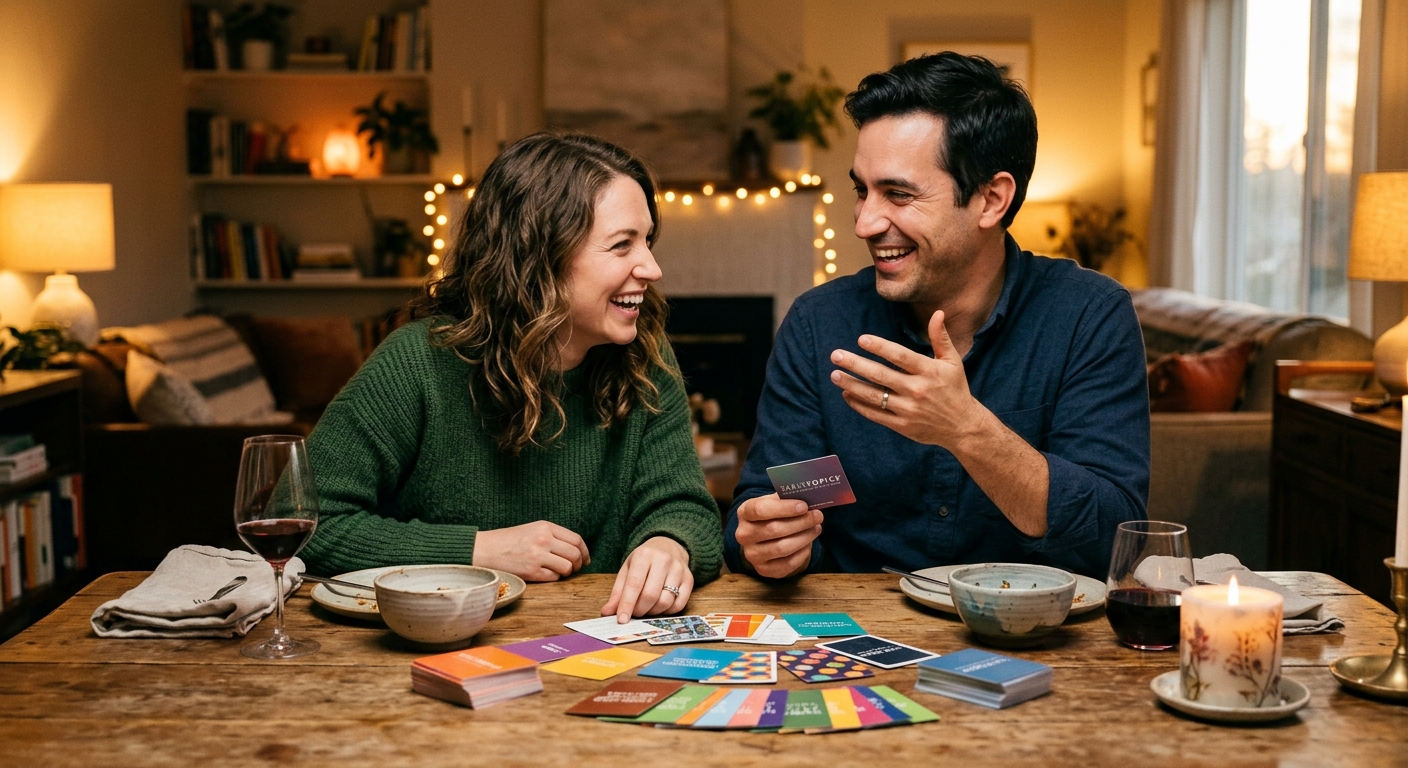
You and your spouse are sitting across from each other at dinner. The kids are finally in bed. This is your window — your actual chance to talk. And somehow, you end up discussing whether you need to reorder dish soap.
It happens to almost every long-term couple. Not because you've run out of things to say, but because everyday life has trained you to talk about logistics. That's exactly why the best conversation tools for married couples aren't a luxury — they're a practical reset button. But here's the thing: not every tool works for every couple, and choosing the wrong format can make the whole experience feel awkward or performative.
This guide cuts through the noise. We've compared real products across specific use cases — so you can pick what fits your actual life, not just what's trending on Pinterest.
Why Physical and Digital Conversation Tools Work Better Than Willpower Alone
Most couples don't lack the desire to connect more deeply. They lack a structure that makes it easy.
Willpower is a finite resource. After a full workday, parenting, and the thousand micro-decisions that make up modern life, sitting down and spontaneously generating meaningful conversation feels like one more task. Conversation tools — whether card games, apps, or downloadable PDFs — remove the activation energy. Someone else has already done the hard work of crafting the question. You just have to answer it.
Research from the Gottman Institute, which has studied couples for decades, consistently shows that small, regular moments of emotional attunement build more relationship satisfaction than infrequent big gestures. A conversation card pulled three times a week does more than a single deep weekend retreat once a year. And if you're already exploring conversation starters for married couples, you already understand that having the right prompt at the right moment changes everything.
What to Look for in a Couples Conversation Tool
Before we get into specific products, let's talk about what actually separates a good tool from a forgettable one.
Question Variety and Depth Range
The best tools offer a spectrum — from light and playful to genuinely vulnerable. A deck that's all heavy emotional processing will exhaust you. One that's only fun and silly won't move the needle on intimacy. Look for tools that let you choose your depth level based on your energy that day.
Ease of Use in Real-Life Couple Scenarios
Can you use it in the car? At a restaurant? When one partner is half-asleep on the couch? The more friction a tool creates, the less you'll use it. This is where format becomes a real differentiator — and where many otherwise great products fall short.
Format: Cards vs. Apps vs. Printable PDFs
This deserves its own section (and gets one below), but the short version: physical cards feel more intentional and less like another screen; apps are more accessible but compete with notifications; printable PDFs are budget-friendly and flexible but require some DIY setup.
Top Conversation Card Games for Married Couples (Reviewed)
Best for Deep Emotional Connection: We're Not Really Strangers
Originally designed for any relationship, We're Not Really Strangers has become a cult favorite among couples specifically because of how well it layers emotional depth. The game moves through three levels — Perception, Connection, and Reflection — and the questions get progressively more vulnerable.
For couples who feel like they know each other well but want to discover new layers, this one consistently delivers surprises. (I've seen couples who've been married 20+ years genuinely catch each other off guard with answers here.) At around $25-$30, it's a solid investment for the experience it creates.
Best for: Long-married couples ready to go below the surface. Not ideal for couples who find vulnerability uncomfortable without some warm-up.
Best for Lighthearted Fun and Laughter: TableTopics Couples Edition
TableTopics has been around for years and remains one of the most accessible card game formats on the market. The Couples Edition focuses on nostalgia, humor, and playful hypotheticals — questions like 'What's the most embarrassing thing I've done in public?' create laughter and connection without pressure.
The cards are high quality, the box is compact, and the questions are consistently fun without feeling shallow. At $25-$35, it's comparable in price to We're Not Really Strangers but a totally different energy.
Best for: Couples who want to inject more fun and lightness into their relationship. Great for date nights and dinner tables. Also works well with couple friends.
Best for Deep Clinical Insight: Gottman Card Decks
If you want the research-backed approach, the Gottman Card Decks (available as both physical cards and a free app) are in a category of their own. Developed from Dr. John Gottman's decades of couples research, the decks are organized by purpose — Love Maps (learning your partner's inner world), Open-Ended Questions, Salsalito Cards (expressing appreciation), and more.
The free app version gives you access to multiple decks immediately, which is genuinely impressive for couples therapy tools at zero cost. The physical deck is also available for around $20.
Best for: Couples interested in the psychology behind connection — or those who've done therapy and want to continue the work at home. The structure can feel clinical to some, so pair it with something lighter.
Best for Couples Who Travel or Have Limited Time: Icebreaker by O.School
Icebreaker card sets (various publishers use this format) offer smaller, portable decks that fit in a purse or carry-on. They're not specifically couples-focused, but many couples use them successfully because the format encourages quick, high-energy exchanges rather than long sit-down conversations.
For busy parents, commuters, or couples in long-distance situations, having 15 cards in your bag beats a full deck at home. Pricing varies from $10-$18 depending on the set.
Best for: Time-crunched couples who want something they'll actually use, not something that sits on a shelf looking pretty.
Best Free Printable PDF Option
If budget is a concern — or you want to try before you invest — printable conversation starter PDFs are a genuinely great option. Several relationship coaches and counselors offer free PDF downloads with 30-50 curated questions.
The experience isn't as tactile as a card deck, but if you print them, cut them, and put them in a jar on the kitchen counter, you've created your own ritual. And you can get conversation starters for your marriage in formats designed specifically for this kind of accessible, low-barrier use.
Best for: Couples just starting to build a conversation habit, or those who want to test the format before spending money on a physical product.
Apps vs. Physical Cards: Which Format Suits Your Lifestyle?
Here's an honest comparison to help you decide:
| Factor | Physical Cards | Apps | Printable PDFs |
|---|---|---|---|
| Cost | $15–$35 one-time | Free to $10/month | Free–$10 one-time |
| Portability | Medium (bulky) | High | Medium (print needed) |
| Screen-free experience | Yes | No | Yes |
| Question variety | Fixed set | Often updated | Fixed unless reprinted |
| Feels intentional | High | Medium | Medium |
| Setup friction | Low | Very Low | Medium |
| Great for long-distance | Less ideal | Excellent | Good |
For couples who want a screen-free ritual, physical cards win. For long-distance couples or those who travel frequently, the Gottman app or a conversation starter app is genuinely the most practical choice. And for couples exploring deep conversation topics specifically, apps with expandable question libraries have a clear advantage.
How to Use Any Conversation Tool So It Doesn't Feel Forced
This is the part most product reviews skip entirely. And it's arguably the most important.
The 'feels forced' problem is almost always a ritual problem, not a content problem. Here's what actually works:
1. Attach it to an existing habit. Dinner is the obvious one, but it doesn't have to be. Some couples do one question during their morning coffee. Others pull a card during their Sunday walk. The habit anchor matters more than the time of day.
2. Give yourself permission to skip depth. Not every question needs a 20-minute conversation. Sometimes a one-sentence answer and a laugh is enough. The goal is a regular practice, not a therapy session.
3. Take turns choosing the question. When one person controls the tool, it can feel like homework for the other. Alternating who picks — or who goes first — keeps it collaborative.
4. Start lighter than you think you need to. If your first three sessions with a new deck feel a little surface-level, that's fine. You're building a muscle. Couples who try to go deep immediately often abandon the tool after two uses because 'it wasn't that meaningful.'
So look — the science backs this up. According to research on conversation habits and relationship satisfaction, couples who engage in regular, low-stakes positive interactions show greater long-term connection than those who only communicate during conflict or crisis. Small, consistent wins beat occasional intensity.
If you're also thinking about what makes these conversations flow naturally, it's worth reading about funny conversation starters for long-distance couples — the techniques that work there translate perfectly to in-person settings too.
Our Top Pick for Most Married Couples (And Why)
If I had to recommend one starting point for the average married couple — not the most adventurous, not the most therapy-forward, but the couple who just wants to reconnect without it feeling like a project — it's We're Not Really Strangers.
Here's why it works across more couple types than any other single product:
- The three-level structure means you can start light and go deeper at your own pace
- The questions are genuinely surprising even for long-married couples
- It's designed to be played in one sitting or across many sessions
- The format is elegant enough that couples actually leave it on the coffee table
But — and this matters — if you're in a long-distance marriage, go with the Gottman Card Decks app first. It's free, it works over video call, and it's built on decades of relationship research.
And if you want to build a full conversation practice (not just a one-off game night), pair any physical tool with a curated prompt library. The most connected couples I've seen don't use one tool — they have a rotation that matches their mood and available time.
The right conversation tool isn't the most expensive or the most popular. It's the one that fits into your actual life and gets used. Start there. Build the habit. And let the conversation do the rest.
Ready to build that practice? Get conversation starters for your marriage and explore options matched to your specific relationship style — no guesswork required.